Course Content
Diagnostic Assessment: Exam Readiness and Syllabus Skills
Understand the History 9489 papers, refresh the selected syllabus options and prepare for option-aware diagnostics and a focused learning plan. AS learners use Papers 1–2; full A Level learners also use Papers 3–4.
0/12
STARTING OF HISTORY 9489 AS LEVEL | Quick overview of AS Level Syllabus
AS LEVEL OPTION 1 | European history: Modern Europe, 1750–1921
0/2
HISTORY 9489 (OPTION 1) AS LEVEL SYLLABUS COMPLETED: LET’S GET READY FOR THE EXAM PAPER 1 & 2
EXAM DONE! SUBMIT YOUR GRADE
AS LEVEL OPTION 2 | American history: The history of the USA, 1820–1941
0/2
HISTORY 9489 (OPTION 2) AS LEVEL SYLLABUS COMPLETED: LET’S GET READY FOR THE EXAM PAPER 1 & 2
EXAM DONE! SUBMIT YOUR GRADE
AS LEVEL OPTION 3 | International history, 1870–1945
0/2
HISTORY 9489 (OPTION 3) AS LEVEL SYLLABUS COMPLETED: LET’S GET READY FOR THE EXAM PAPER 1 AND 2
EXAM DONE! SUBMIT YOUR GRADE
STARTING OF HISTORY 9489 A LEVEL | Quick overview of A Level Syllabus
TOPIC 1: The origins of the First World War
Candidates will study the following content and the differing interpretations that historians have produced, with particular focus on the over-arching key question, ‘Who was to blame for the First World War? Key approachesCandidates should explore the following issues through the interpretations and approaches of different historians:• How far was tension between the Great Powers likely to lead to war?• How important were the decisions taken by key individuals in leading to war?• How did Article 231 of the Treaty of Versailles shape the debate about responsibility for war?• How and why did the idea of ‘shared responsibility’ arise?• How did the Second World War affect the debate?• The Fischer thesis• The German reaction to Fischer• Challenges to Fischer• Modern interpretations exploring the responsibility of nations other than Germany• Relative importance of long and short-term factors• How the centenary of the First World War affected the debate: the importance of contingency over motive
0/8
TOPIC 2: The Holocaust
Candidates will study the following content and the differing interpretations that historians have produced, with a particular focus on the over-arching key question, ‘Why did the Holocaust occur?’ Key approachesCandidates should explore the following issues through the interpretations and approaches of different historians:• How far was the Holocaust a consequence of racist ideas which existed before the Nazis?• The Intentionalist approach and the role of Hitler: was the Holocaust planned in advance by Hitler?• The Structuralist approach: how far did the nature of the Nazi state determine how the Holocaust developed?• The Functionalist approach: how far did contingent factors such as war determine how the Holocaust developed?• Synthesis interpretations which aim to reconcile the Intentionalist and Functionalist viewpoints• Perpetrators: who carried out the Holocaust, and why? Was murderous behaviour the exception or were many involved? Why did non-Germans participate in the killings?• Victims: How far did Jews resist the Holocaust, and how can resistance be defined? Did men and women experience the Holocaust in different ways? Should definitions of the Holocaust include victims other than Jews?• Bystanders: How did the USA and Britain respond to the Holocaust at the time?
0/6
TOPIC 3: The origins and development of the Cold War
Candidates will study the following content and the differing interpretations that historians have produced, with a particular focus on the over-arching key question, ‘Who was to blame for the Cold War?’ ContentThis topic covers the following events and developments in the evolution of the Cold War in Europe, 1941–50• Tensions in the wartime alliance against the Axis powers• Peace-making at the end of the Second World War• Increasing tensions in a divided Europe• The Truman Doctrine and the Marshall Plan• The Berlin Blockade and Airlift Key approaches Candidates should explore the following issues through the interpretations and approaches of different historians:• How far were inherent tensions between East and West bound to resurface in 1945?• How important were the personalities of the leaders of the Great Powers in shaping the Cold War?• How far were ideology, security and economics the factors which created Cold War tensions?• The Traditional approach• The Revisionist approach• Post-Revisionist approaches• How have the perspectives on the Cold War of Russian historians differed from those in the West?• Reinterpretations of the Cold War in the light of new archival sources• The emergence of the ‘New’ Cold War history
0/5
HISTORY 9489 (PAPER 3) A LEVEL SYLLABUS COMPLETED: LET’S GET READY FOR THE EXAM PAPER 4
History 9489
Subject-specific resources and references

Cambridge International AS Level History 3rd Edition Modern Europe 1774–1924 Coursebook with Digital Access (2 Years)

Authors Graham Goodlad, Patrick Walsh-Atkins
Publisher Cambridge University Press
Published 2025
ISBN 9781009556200
Format Digital coursebook with 2 year online access

Supports Cambridge International AS Level History (9489) for examination from 2027.
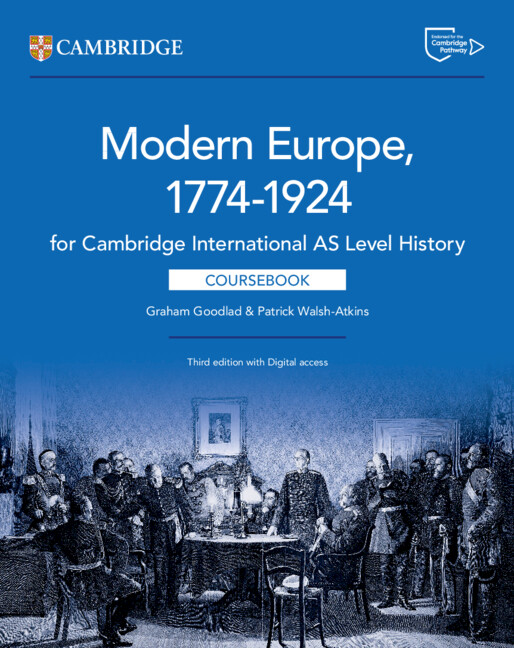
 

Cambridge International AS Level History Modern Europe 1774–1924 Coursebook with Digital Access (2 Years)

Description

This coursebook provides comprehensive coverage of modern European history from 1774 to 1924, helping students develop historical knowledge, source analysis skills, and essay-writing ability. It is designed to support international learners preparing for the Cambridge AS Level History syllabus.

The book includes a wide range of activities, source-based tasks, and practice questions that encourage independent learning and critical thinking while building confidence for assessment.

Core areas covered include:

• France from the late monarchy to the fall of Napoleon (1774–1814)
• Liberalism and nationalism in Germany and unification (1815–1871)
• Russia from Tsarist rule to the Bolshevik Revolution (1855–1924)
• Key political, social, and ideological developments in modern Europe
• Preparation for examinations and historical skills

Activities throughout each chapter promote reflection, discussion, and deeper understanding of key historical concepts and debates.

Get this Book


Cambridge International AS Level History: Modern Europe 1774–1924

Authors Nicholas Fellows, Mike Wells
Publisher Hachette Learning
Published 2025
ISBN 9781036008949
Format Paperback

Supports Cambridge International AS Level History syllabus (9489/9981) for examination from 2027.
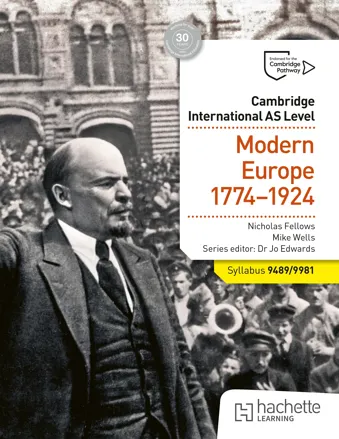
 

Cambridge International AS Level History: Modern Europe 1774-1924

Description

This student book provides comprehensive coverage of the Modern Europe 1774–1924 option, helping learners develop both historical knowledge and analytical skills. It explores key political, social, and economic developments across Europe during a period of major transformation.

Chapters are structured around key questions and supported by a wide range of historical sources, activities, and practice questions to build interpretation and evaluation skills.

Core areas covered include:

• Revolutionary movements and political change
• Nationalism and state formation in Europe
• Industrialisation and social developments
• International relations and conflicts
• The causes and impact of major wars
• European transformations up to 1924

Activities throughout the book encourage independent learning, critical thinking, and exam preparation while bringing modern European history to life through engaging narratives and analysis.

Get this Book

Notes & Resources
History 9489 Learning Resources.pdf
Size: 136.49 KB
0% Complete